Keep a Small Creative Project Moving
A gentle framework for defining a bounded creative project, choosing a useful next action, and recognizing when the work is ready to share.
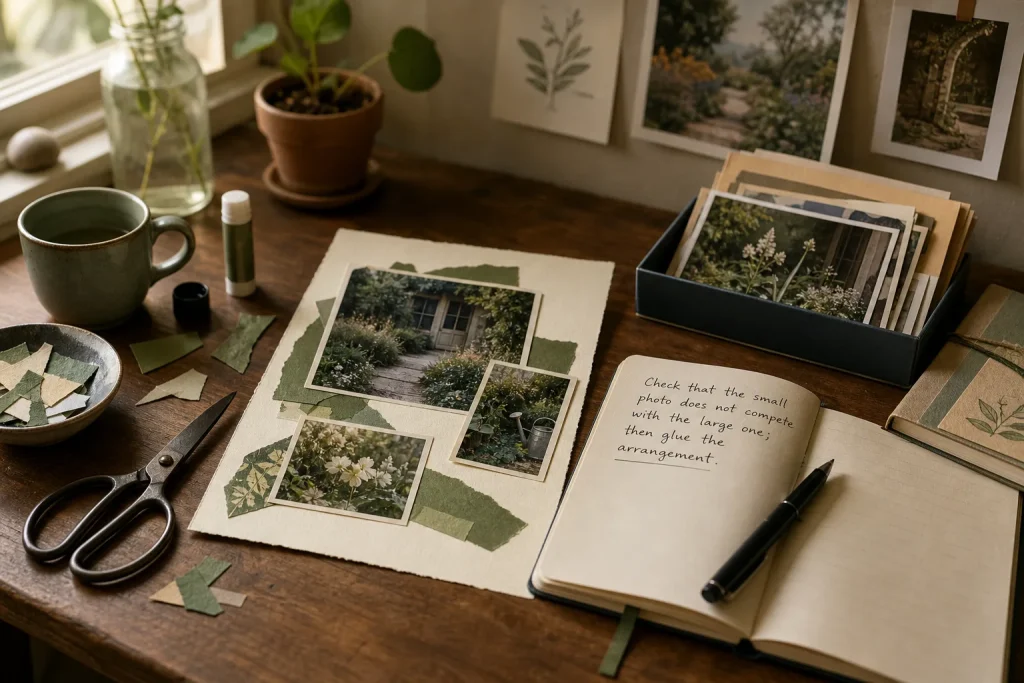
A half-finished collage sits beside the scissors, while a folder of saved images keeps growing. The project may feel stalled, but often the difficulty is simpler: its edges are unclear, and the next move asks for too many decisions at once. A small project can move again when you define what belongs in it, choose an action you can begin, and decide what “ready” will mean before polishing takes over.
Give the project a shape you can hold
Start by describing the finished work in one plain sentence. Name the form and the limit: a short story with one viewpoint, a set of three recipe cards, a paper collage for a particular wall, or a brief audio piece built around one sound. A useful description makes the project imaginable without dictating every detail.
Then set boundaries in the materials and time you are willing to give it. You might use only the photographs already on your phone, work with a single sheet of watercolor paper, or write in a notebook during a few quiet evenings. These are not rules for proving your seriousness. They are a way to keep possibility from expanding faster than the work.
It helps to name what the project is not. A small zine does not also need to become a website, a social account, and a complete record of its subject. Keep those ideas in a separate note. You can return to them later without allowing them to enlarge the current task.
Choose a first action that leaves a trace
Once the boundaries are clear, choose an action that produces something visible or audible. “Work on the story” is hard to start because it contains many decisions. “Write the scene where the neighbor returns the key” gives you a place to begin. Other useful actions include sorting images into two piles, recording a rough voice note, or cutting a handful of paper shapes.
Make the action small enough that you can tell when it is done. It should usually leave a trace you can see: a paragraph, a rough arrangement, a list of possible titles, or a recording with a clear beginning. The trace matters because it gives your next session something specific to respond to.
If even a modest action feels difficult, reduce the decision load rather than waiting for motivation. Open the document and mark the paragraph that needs attention. Put the chosen materials on the table. Write three possible opening lines without selecting one. Preparation can be a legitimate next action when it removes a real obstacle, but keep it connected to making the work.
Use the last few minutes to choose what comes next
When you stop, leave a short note for your future self. Record what changed and the next physical or mental move: “The blue shapes make the page crowded; remove the two smallest before adding text.” This is more useful than “continue collage,” because it preserves the question you were considering.
Keep the note where you will meet the project again: at the top of a document, beside the sketchbook, or in a card tucked into the folder. If the next action depends on a decision you cannot yet make, write down the options and what each would change. For instance, a quieter ending might suit a reflective story, while a sharper one could make its central choice clearer.
Use a simple parking place for new ideas that do not fit the present scope. A scrap-paper list is enough. This lets you acknowledge an appealing possibility without treating every new thought as a reason to revise the project’s boundaries.
Review the work against its original purpose
After you have a rough whole, pause before adding more. Compare what exists with the sentence you wrote at the start. Does the work have the form you intended? Can a reader, listener, or viewer follow its central idea? Which missing piece would make it feel incomplete, and which proposed addition is only attractive because it is new?
Choose one revision at a time. For a short text, you might clarify the order of events before adjusting individual sentences. For a handmade card, you might check whether the lettering can be read before adding decorative marks. This sequence keeps surface polish from disguising a structural problem.
Leave some roughness where it serves the work. A handmade edge or an informal phrase can be part of its character. The question is not whether every detail could be improved; it is whether the remaining changes would make the work clearer or more coherent for the purpose you chose.
Decide what ready to share means
“Ready” need not mean flawless. Decide what would make this particular piece suitable for its intended audience and setting. A poem shared with a small writing group may need a readable draft and a question for feedback. A recipe card meant for a friend may need clear instructions and a legible layout. The standard follows the use, not an imagined universal bar.
Choose the audience and the form of sharing deliberately. You could show a print to one trusted person, read a short passage aloud, or place a finished illustration in a portfolio. A narrow first audience can make feedback easier to interpret. Ask for a response that helps with a real decision, such as whether the main idea comes through, rather than a general verdict on whether the work is good.
If sharing would expose private material or involve professional, legal, or safety concerns, consider those boundaries before sending or posting anything. You can also choose not to share. Completing a project and making it public are separate decisions.
A hypothetical worked example with a paper collage
Imagine a person with a small stack of old garden photographs, one sheet of cream paper, glue, and a free evening. They want to make a collage for a friend, but they do not want to turn it into a larger album. They define the project as one finished page built from three photographs and scraps of green paper; no captions or frame are required.
They begin by choosing the three photographs and placing them on the page without glue. Their next action is to move the images until one clear focal point emerges, then cut green scraps to connect the edges. At the end of the session, they leave a note: “Check that the small photo does not compete with the large one; then glue the arrangement.”
When the collage is assembled, they compare it with the original aim. If the photographs are easy to recognize and the page feels balanced, they stop adding decoration. They decide it is ready to show their friend in person. The tradeoff is a deliberately modest piece rather than a comprehensive album, but that smaller scope makes a complete gift possible.
A project can also change course without becoming a failure. If you discover that the chosen form no longer suits the idea, revise the one-sentence description and choose a new next action. Keep the change explicit. Knowing what you are making, what you will do next, and who it is for is often enough to bring a modest piece of creative work to a satisfying finish.