How to Watch a Film More Attentively
A spoiler-free set of prompts for noticing framing, sound, pacing, and point of view without turning a film into homework.
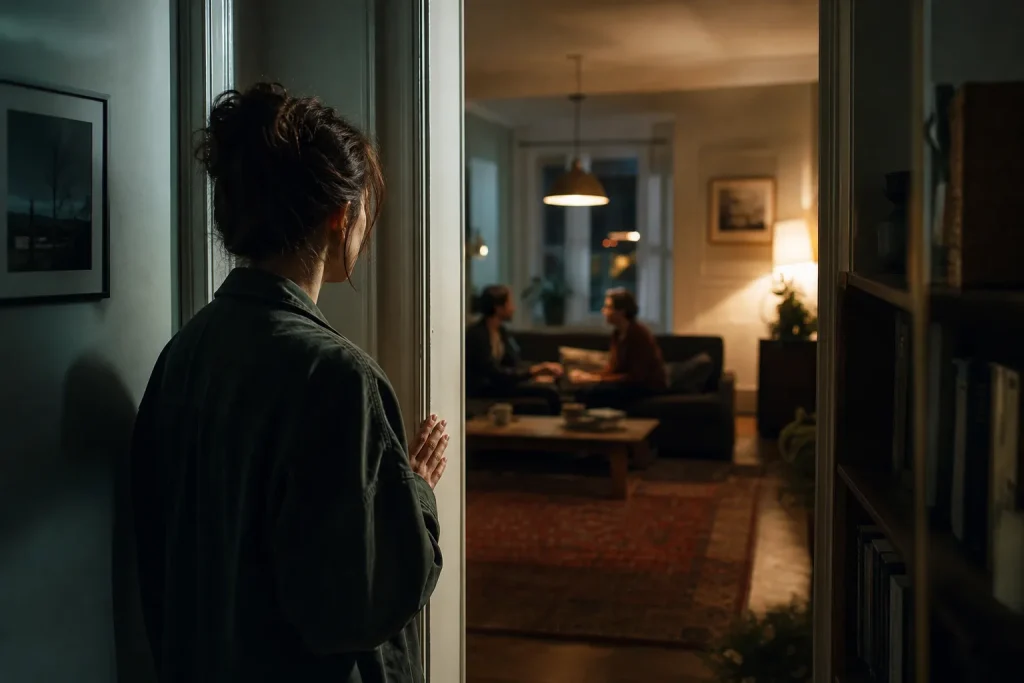
A character pauses at a doorway, and the room behind them stays in view. Before anything is explained, that small arrangement can suggest hesitation, privacy, or a choice not yet made. Watching attentively means giving such moments room to register—not trying to decode every image while the story moves on.
These prompts are designed to be used lightly. Choose one or two before a screening, or return to them afterward. They do not require film terminology or advance knowledge of the plot, and none depends on spoilers. The aim is to notice how a film guides attention and feeling, then decide what those choices contribute.
1. Notice what the frame includes and leaves out
A film’s frame is a boundary as well as a picture. It determines which faces, objects, and spaces are visible, while everything outside it remains unseen. When a scene begins, take in the whole arrangement before settling on the most obvious subject.
Ask where the characters sit in relation to the edges. Does a face fill the image, or does the room occupy more space? Is there a gap between people? A doorway, window, or stretch of empty wall can matter as much as a person speaking. The frame may make a character seem isolated, crowded, watched, or protected without spelling out that impression.
Then consider what you cannot see. If a person looks toward something beyond the edge, the unseen object or person can become part of the scene’s tension. A sound may also draw attention to an off-screen space. You need not guess what is there; notice simply that the film has invited your imagination to complete the image.
Try not to treat every detail as a hidden clue. A useful question is less “What does this object symbolize?” than “Why am I looking here now?” The first answer may be practical: the composition makes a conversation easier to follow. The second may be more open: the background seems to carry a mood the dialogue does not name.
2. Watch how the camera relates to people
Camera position can make a scene feel close or distant, steady or unsettled. Notice whether the image seems to observe from across a room, stay near a character’s face, or move along with someone. This is not a test of camera vocabulary. You are tracking the relationship between the viewer and the people on screen.
A close view can make a quiet expression difficult to ignore, but it can also withhold the surroundings that would explain it. A wider view may preserve the group’s behavior, showing who listens, who turns away, and who has room to move. If a camera follows one person, ask what becomes visible because it follows them—and what remains outside that path.
Pay attention to changes rather than trying to label every shot. A scene that begins with several people in view might gradually give one person more space. The shift can alter whose experience feels central. If the camera stays still while the characters move through the frame, the resulting distance may feel different from a camera that accompanies them.
Keep your interpretation provisional. A low or high viewpoint does not carry one fixed meaning in every film. Its effect depends on the surrounding images, the actors’ gestures, and the scene’s mood. Describe the immediate feeling first—exposed, intimate, detached, uncertain—then ask which visual choice helped produce it.
3. Listen to the layers around the dialogue
Dialogue tends to claim attention, so set it aside for a moment and listen to what else is present. There may be room tone, traffic, wind, footsteps, an appliance, music, or an abrupt absence of sound. These layers establish a place, but they can also shape how a conversation feels.
Notice whether sounds seem to belong to the room or to the film’s musical score. A cup placed on a table has a different quality from a musical note that continues beyond the movement. You do not have to identify the production method; it is enough to hear how one sound sits beside another.
Ask what the film makes prominent. A door closing might sound unusually sharp; a busy street might soften until two voices stand out. When the soundscape changes, notice whether your attention follows the image, a speaker, or something beyond the frame. The ear can point toward a source the camera has not shown.
Silence is worth noticing, too, though it rarely means that the soundtrack contains nothing. A pause may leave room for breath, cloth moving, or a faint mechanical hum. Consider whether the quiet feels restful, awkward, or tense. That response can reveal how much pressure the scene places on a simple pause.
4. Track the rhythm of cuts and pauses
Pacing is not just speed. It is the pattern of waiting, movement, repetition, and change that lets a scene breathe or presses it forward. Notice how long the film stays with a face, an empty space, or an action after you think you have understood it.
A quick run of images may feel energetic, but rapid cutting can also create confusion or strain. Longer shots can invite close observation, yet they may also make a moment feel exposed. The effect depends on what is happening within the shot and what the film has trained you to expect.
Look for changes in rhythm across a scene. Does the editing become more frequent as a conversation grows difficult? Does a cut arrive before a gesture is complete, or does the camera wait until afterward? The timing can make an action feel decisive, uncertain, or strangely ordinary.
Repetition offers another clue. If the film returns to a similar view, sound, or movement, notice whether it feels familiar or altered by its new context. You do not need to predict where the pattern leads. Simply register that the repetition has changed how the moment lands.
5. Ask whose point of view shapes the scene
A film can show a character without showing the world as that character sees it. Point of view involves more than a literal shot through someone’s eyes. It can come from which reactions receive time, what information is withheld, and whose attention seems to organize the scene.
When a new person or place appears, ask what you know and how you know it. Did the film give you a character’s reaction before showing what they see? Did it keep you near one person, or move freely among several? The sequence of images can create curiosity, uncertainty, or a sense of closeness without making the camera a character’s direct gaze.
Notice whose response is easy to read and whose remains opaque. A scene might offer one person’s face in detail while showing another mostly from behind. That difference can make the viewer feel aligned with one character, or leave the group’s balance unresolved. Avoid assuming that access equals agreement: being close to a character does not require endorsing them.
This prompt is especially useful when the film’s emotional center seems to shift. Ask whether the shift comes from new information, a change in framing, or a different character’s reaction. Sometimes the story has not changed much, but the way you are positioned to receive it has.
6. Observe how objects and places shape behavior
Settings are not merely backgrounds. A narrow corridor, an open field, a crowded kitchen, or a bare office gives people different possibilities for moving and meeting. Watch how characters use the space: who crosses it, who stays at its edge, and who seems to control the shared area.
Objects can work in equally practical ways. A chair may separate people, a coat may mark someone’s arrival or departure, and a phone may interrupt a conversation. Begin with what the object does in the scene. If it seems to carry additional meaning, let that reading grow from its placement and use rather than treating it as a secret code.
Notice whether a location changes as the scene continues. A room first shown as welcoming may feel less comfortable once a character is alone in it. A familiar object can seem different when the camera returns to it after a tense exchange. The place has not necessarily changed; your attention has.
Also consider what the setting asks the actors to do. A low ceiling may make someone stoop. A table may force a conversation into opposing sides. Physical constraints help make behavior legible, and they can quietly connect a character’s choices to the space around them.
7. Let performance register before you interpret it
Facial expressions are only part of acting. A held posture, a delayed answer, a glance toward a door, or hands that keep busy can make a moment feel open to several readings. Notice the action itself before deciding what it means.
Try describing a performance with plain verbs: waits, turns, avoids, offers, withdraws. Then ask how the camera and sound direct your attention to that behavior. A brief movement might carry weight because the scene has been quiet, or because the film has kept the actor’s hands in view.
Compare what is said with what the body does, without assuming the words are false or the gesture is a confession. The two may simply pull in different directions. That tension can make a conversation feel guarded, affectionate, formal, or difficult to settle.
Giving performance this kind of attention is not the same as judging whether an actor is convincing. It is a way to see what choices shape the encounter. You may find that the most memorable moment is not a speech, but the beat just before someone answers.
8. Keep a question instead of chasing a verdict
Attentive viewing can become tiring if every image seems to demand an explanation. Replace the hunt for a single hidden meaning with a question you can carry through the film: What makes this space feel safe? Why does the sound draw me away from the speaker? Whose reaction is the scene asking me to wait for?
One question is usually enough. If you watch with someone else, you can compare what each person noticed afterward without requiring agreement. A friend may have followed the music while you watched the background; both observations can be useful, even if neither settles what the scene means.
If a moment passes before you can form an interpretation, let it pass. You are not required to pause, rewind, or turn the viewing into a quiz. A brief mental note—“long pause,” “empty doorway,” “sound from outside”—can preserve the observation without interrupting the film.
Hypothetical worked example: Imagine watching a fictional drama in which two siblings speak in a kitchen. You decide to follow only the relationship between sound and space. The dialogue is clear, but a refrigerator hum continues beneath it; when one sibling leaves, the camera stays with the empty kitchen and the hum becomes easier to hear. You note the sequence without deciding that the appliance symbolizes anything. The expected result is a more specific question to consider afterward: did the quiet make the departure feel ordinary, or did the unchanged room make it feel sharper? The tradeoff is that you may notice fewer details elsewhere, which is why one focused prompt can be more rewarding than trying to track every craft choice at once.
After the film, choose one observation and connect it to your response. Perhaps the long pause made a conversation uncomfortable, or the wider framing made a character seem alone within a group. That modest link between what you saw and how it felt is often enough. The next time you watch, a different detail may take the lead.