A Study Session That Ends With Something You Can Recall
Turn a reading session into a compact set of cues you can use later, with a routine for choosing what matters, writing useful questions, and checking recall without rereading everything.
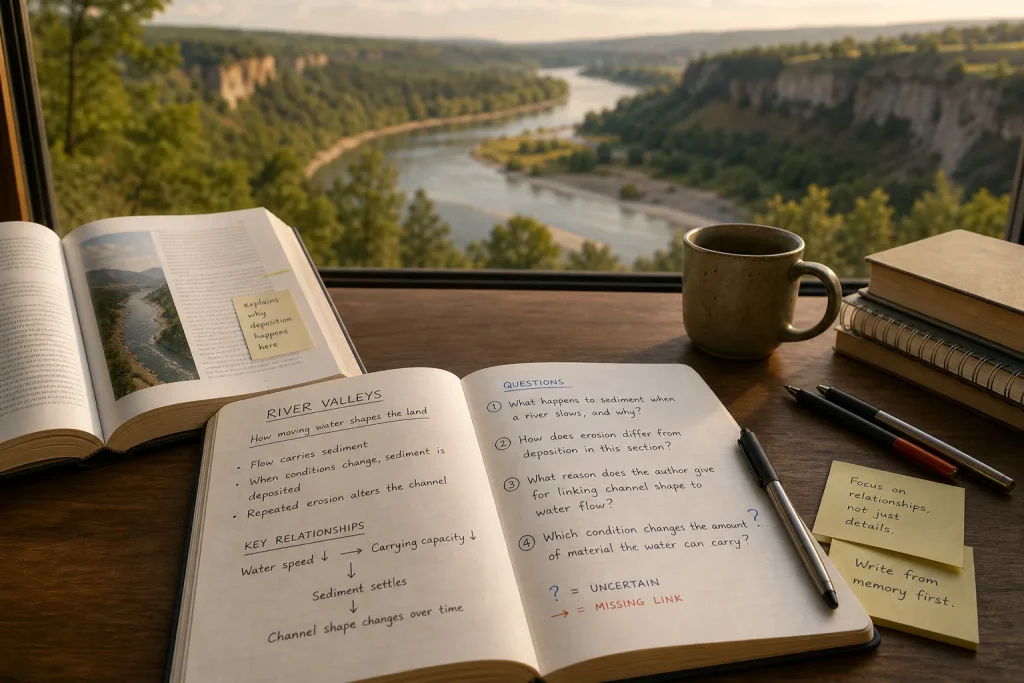
You close a chapter on how rivers shape their valleys, then look at your notes and find three pages of copied sentences. They are accurate, but they do not tell you what to try to remember when you return. A more useful study session ends with a small set of ideas in your own words and questions that prompt you to retrieve them.
This routine does not require an elaborate system. A book or article, a sheet of paper or plain text document, and a few quiet minutes at the end are enough. The aim is not to preserve every detail. It is to create a compact path back to the material: what it was about, how its parts fit, and where your understanding still feels thin.
Read for structure before collecting details
As you begin a section, first identify its job. Is it explaining a process, comparing two positions, defining a concept, or giving evidence for a claim? A brief heading scan can help, but treat headings as clues rather than a substitute for reading. After a page or short subsection, pause and ask what changed in your understanding.
That question shifts attention from sentences to relationships. In a chapter about river valleys, for instance, you might notice a sequence: moving water carries sediment, the flow deposits it where conditions change, and repeated erosion alters the channel. This structure is easier to recall than a stack of isolated terms because each part gives you a cue for the next.
Mark sparingly. A pencil line beside a key passage or a short margin note can flag material worth revisiting, but highlighting alone does not make a usable note. When a passage seems important, record why: “explains why deposition happens here,” or “contrasts gradual erosion with sudden change.” That small annotation preserves the passage’s role, not just its location.
Close the source before drafting notes
When you finish a manageable section, look away from the page or close the document. Write a short account from memory before checking the source. Aim for a handful of sentences: the central point, the steps or relationships that support it, and one detail that seems necessary to understand the point.
Writing before looking back exposes the difference between recognition and recall. A familiar sentence can feel easy to understand while it is in view. With the source closed, you have to rebuild the idea yourself. The result may be incomplete. That is useful information, not a reason to abandon the method.
Keep the language plain and yours. If the text says, “sediment is deposited as carrying capacity declines,” you might write, “When water slows, it cannot carry as much material, so some of it settles.” If you cannot put an idea into clear words, mark the uncertain part instead of disguising it with copied phrasing. You can check that point against the source afterward.
Once you have made the first attempt, reopen the text and compare. Correct errors, add an essential missing link, and remove details that are merely decorative. Distinguish between a correction and a new idea by marking them differently if that helps—for example, use a question mark for uncertainty and an arrow for a missing connection.
Turn notes into questions with useful cues
A note becomes more useful for later review when it can prompt a response. Convert important points into questions that require you to explain, connect, or distinguish, rather than questions answered by a single word whenever possible.
- For a process: “What happens to sediment when a river slows, and why?”
- For a comparison: “How does erosion differ from deposition in this section?”
- For a claim: “What reason does the author give for linking the channel’s shape to water flow?”
- For an uncertain point: “Which condition changes the amount of material the water can carry?”
A question needs a clear cue. “What did I read?” is too broad; it can lead to a vague answer or a complete rereading. Naming the concept or relationship narrows the task while still requiring thought. If a question only asks for a label, add a second part: “What is deposition, and what causes it in this example?”
Keep questions close to the notes they refer to, but separate them visually. One simple format is a two-column page: cues on the left, answers or compact explanations on the right. In a digital document, a heading for “Questions” followed by a short answer key works just as well. The format matters less than being able to cover the answer while attempting the question.
Keep the record small enough to revisit
Brief notes are easier to use than a second version of the source. A practical page might contain a one-sentence summary, a few connected points, and several questions. Choose details by asking what would help you reconstruct the main idea later. A colorful example may be memorable but unnecessary; a distinction that prevents confusion may be worth keeping.
Do not force every section into the same number of bullets. A simple passage may need only a summary and one question. A dense argument may need a small outline showing its claim, reasons, and qualification. The measure is whether the page helps you explain the material without the original text open, not whether it looks uniform.
Use specific labels rather than relying on page numbers alone. A note titled “How slower water deposits sediment” will be easier to recognize than “Chapter notes.” If you are working through a long book, include the chapter or section name as well. This gives you enough context to find the source when a question reveals a gap.
Check recall without turning review into rereading
At the end of the session, cover the answers and try the questions aloud or on a blank area of the page. Give each one a direct response, then check it against your notes and the source where needed. If you can name a term but cannot explain its role, the question has done its job: it has shown you what still needs attention.
When an answer is weak, avoid rewriting the whole section. Add the missing link to the answer key or make the cue more precise. For instance, if “Why does sediment settle?” produces only “because the river slows,” revise the response to include the connection between slower flow and reduced carrying capacity. A useful correction repairs the explanation rather than expanding the archive.
Later, return to the questions before reopening the reading. Space between attempts gives you a chance to discover what remains available from memory. If an answer has faded, make another attempt, check it, and leave the question in place for another review. If it comes back readily, you can give it less attention and focus on the harder distinctions.
Choose when a question is too demanding
A question can be so broad that answering it becomes a memory search with no clear starting point. “Explain river valleys” may cover a whole chapter. Break it into cues for the process, the conditions, and the evidence. Conversely, a question can be so narrow that it tests an isolated word without the idea around it. Pair terminology with a request to explain or use it.
Be cautious with notes that flatten disagreement or uncertainty. If an author presents a claim with limits, preserve those limits in the question. Ask, “Under what conditions does this explanation apply?” rather than turning a qualified argument into an absolute rule. The note should help you remember the shape of the source, including where it stops.
It is also fine to leave a question unresolved at the end of a session. Label it as open, and record what you need to check: a definition, a diagram, or a step in the reasoning. That is more helpful than writing a confident answer from guesswork. When the subject has practical consequences beyond study, such as health, legal, or financial decisions, notes are a learning aid rather than a substitute for qualified advice.
Hypothetical worked example: a short section on river valleys
Imagine you have twenty minutes to read a short textbook section before a class discussion. It introduces erosion, sediment transport, and deposition, but you find the terms easy to mix up. Your constraint is to finish with notes that fit on one page, not to summarize every paragraph.
You read one subsection at a time, marking only passages that explain a relationship. After the first subsection, you close the book and write: “Moving water wears away material and carries it downstream.” You reopen the text and notice that your sentence leaves out the conditions that affect transport. You add a brief note that the water’s ability to carry sediment changes with its flow.
For the next subsection, you write from memory that material settles where the water can no longer carry it. Checking the source prompts you to make the explanation more precise: slower flow can reduce carrying capacity, so sediment is deposited. You keep that as the connection, rather than copying the textbook’s full explanation.
Your page ends with three questions: “What is the difference between erosion and deposition?” “How does flow affect sediment transport?” and “Why can slower water leave material behind?” You try to answer each without looking. If you can explain the first two but cannot connect slower flow to carrying capacity, that gap becomes the next thing to revisit. The tradeoff is deliberate: the page leaves out many details, but it preserves the relationships most likely to help you rebuild the section.
End with a cue, not a transcript
Before putting your notes away, make the next useful action obvious. Add a small mark beside questions you could not answer, name the source section, and leave the answer covered or separate from the cues. On your next return, start by trying to recall, then consult the source only where your answer needs repair.
A study session does not need to produce polished notes to be worthwhile. It needs to leave you with a few accurate prompts, a compact account of the main idea, and a visible place to begin again. When that record preserves relationships rather than whole passages, revisiting the material becomes an act of remembering and refining—not simply reading the same page once more.