A Simple Way to Plan a Week Without Filling Every Hour
A flexible weekly plan separates what matters, the time actually available, and space for work that cannot be predicted. Follow one hypothetical week from a messy Monday morning to a usable Friday review.
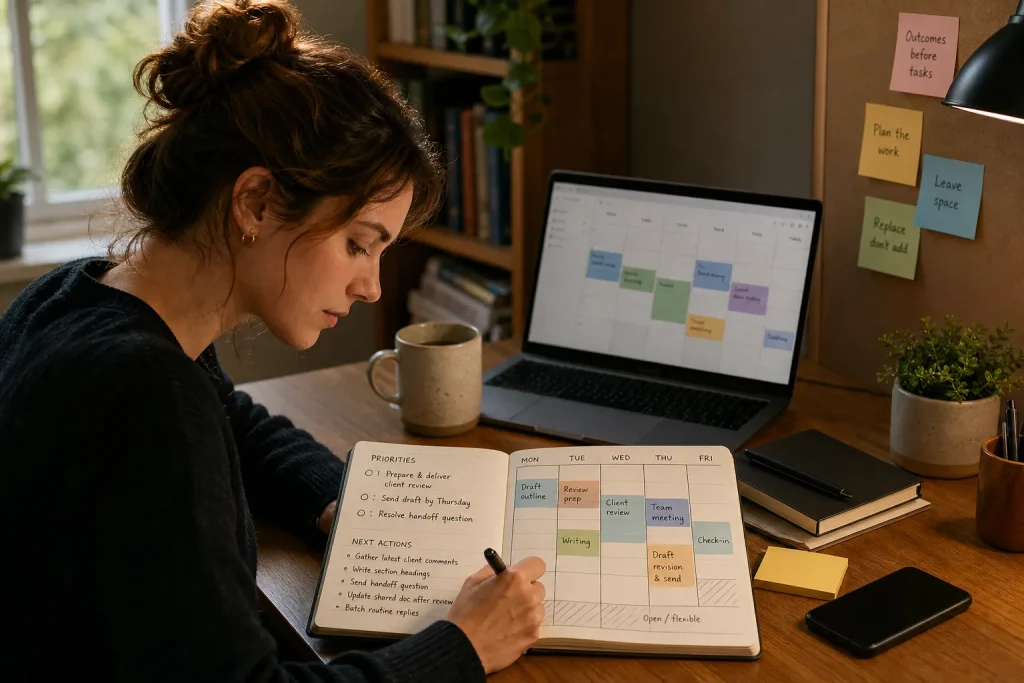
On Sunday evening, Maya opens her calendar and sees a week that looks fuller than it is. A client review is fixed for Tuesday, a draft is due Thursday, and two afternoons contain meetings. The rest is a scatter of reminders, unanswered messages and tasks she has been carrying forward. She could fill every blank with an item from the list. Instead, she makes a plan that names the week’s priorities, marks the time she can really use and leaves some of it unclaimed.
Maya is an invented example, not a real case. Her situation is ordinary enough to be useful: several obligations, work that needs concentration, and uncertainty about what will arrive. The point is not to copy her schedule. It is to see how a weekly plan can guide decisions without pretending the week will obey it.
Start with what the week must carry
Maya begins with two separate sources: her calendar and her task list. The calendar contains commitments with a time or a deadline. The list contains everything else, including tasks that feel urgent simply because they have been waiting. Keeping these sources distinct helps her avoid treating every item as a fixed appointment.
She scans the calendar first. The client review on Tuesday is fixed. A team meeting on Wednesday and a check-in on Friday are also commitments. The draft is due Thursday, but no one has reserved time for writing it. That difference matters: a deadline is not the same thing as a work session.
Next, Maya asks which outcomes would make the week feel meaningfully advanced. She chooses three:
- Prepare and deliver the client review.
- Send a solid draft by Thursday.
- Resolve a handoff question that is blocking a colleague.
These are priorities, not a complete inventory. Replying to routine messages and updating a shared document still matter, but they do not need to compete with the three outcomes for the same mental space. Maya writes the priorities at the top of a note, where she can see them while arranging the week.
She also checks for tasks that are not hers to schedule yet. A project decision depends on another team, so she records a follow-up rather than pretending she can complete the decision herself. This keeps the plan honest about dependencies.
Count usable time, not blank calendar space
A blank stretch on a calendar does not automatically mean available work time. Maya knows that the Tuesday review needs preparation, and she usually needs a pause after a meeting before she can switch into concentrated writing. She marks those transition and preparation needs before placing tasks.
She then makes a rough map of the week using broad blocks rather than a minute-by-minute timetable. Monday morning is suitable for outlining the draft. Tuesday morning is reserved for review preparation; the meeting itself occupies the afternoon. Wednesday has a team meeting and a limited stretch for writing. Thursday morning is the best remaining period for completing and sending the draft. Friday includes a check-in and room to handle loose ends.
This map is based on the time she can reasonably protect, not every theoretical opening. She leaves parts of several days unassigned. Those spaces are not failures to plan. They are what allow the plan to survive a delayed meeting, a request that needs attention, or a task that takes more thought than expected.
To keep the map usable, Maya chooses broad labels such as “draft” or “review preparation,” then keeps the actual next action in her task note. For the draft, that action is to gather the client’s latest comments and write the section headings. A block labelled only “work” would be too vague to help her begin.
Place priorities before secondary tasks
With her available blocks visible, Maya gives each priority a home. She puts the draft outline on Monday, reserves Wednesday for a substantial writing pass and keeps Thursday morning for revision and delivery. The review gets preparation time on Tuesday morning. She sends the handoff question early in the week, so her colleague has a chance to respond before Friday.
Only after those blocks are in place does Maya add smaller tasks. She groups routine replies into a short batch rather than allowing messages to interrupt every open stretch. She adds a reminder to update the shared document after the review, when she will have the needed information. Items that have no consequence this week stay on the longer list.
The order is important. If Maya had scheduled small, easy tasks first, they might have occupied the best writing periods simply because they were quick to place. Planning by priority does not mean ignoring administrative work. It means deciding how much room it deserves after the week’s essential outcomes have a plausible path.
Keep a visible reserve for the unexpected
Maya leaves a modest amount of open time across the week, including one stretch on Friday that could absorb follow-up work. She does not label every reserve block “catch-up,” because that can invite the same backlog to expand indefinitely. Instead, she treats open space as available capacity and decides what it is for only when a real need appears.
She also chooses a simple rule for interruptions: if a new request is genuinely time-sensitive, she will identify which planned task must move before agreeing to it. If it can wait, she will record it and return to the current block. This turns “Can I fit this in?” into a more useful question: “What will this replace?”
That question is not a refusal. It is a way to make tradeoffs visible. A colleague may need help urgently, and the draft may still be due. Maya can then discuss a changed scope or ask someone else to take part of the work, rather than silently assuming she can add more hours to the week.
Hypothetical worked example: when a new request arrives
Suppose Maya’s starting situation is the week described above: a Thursday draft deadline, a Tuesday client review, a Wednesday team meeting, and three chosen outcomes. On Tuesday afternoon, a colleague asks her to prepare a detailed handout for a separate meeting later in the week. The request is real in this hypothetical situation, but the example is invented; it is not a report of an actual workplace event.
Maya first asks when the handout is needed and what it must contain. The colleague says a short set of talking points would be enough by Friday; a detailed handout would be helpful but is not essential. Maya checks her plan. The Thursday draft still needs its revision block, while Friday has open capacity. She offers to send concise talking points on Friday and records that smaller deliverable. The expected result is that the colleague receives useful material without displacing the draft’s protected writing time. The tradeoff is that the more polished handout waits, and the colleague must decide whether the shorter version is sufficient.
If the colleague had instead needed a complete handout before Thursday, Maya would have needed to renegotiate something else: reduce the draft’s scope, ask for help, or agree on a later delivery. The weekly plan cannot make competing obligations disappear. It makes the conflict clear early enough to discuss.
Review the plan without turning it into a scorecard
At the end of each day, Maya takes a brief look at what changed. She moves a task when its conditions have changed, not merely because the original block has passed. If the client review produces new questions, she adds a follow-up. If a planned writing session was interrupted, she chooses the next available suitable block rather than scattering the draft across every remaining opening.
On Friday, she compares the three priorities with what actually happened. She delivered the review, sent the draft and raised the handoff question. The handoff answer is still pending, so she records a next action for the following week rather than treating the unresolved dependency as a personal failure.
Her review also gives her information for the next plan. Perhaps the writing block was too short, or the routine message batch kept expanding. She can adjust the arrangement without drawing a grand lesson from one week. A plan is a working arrangement, not a verdict on how productive someone is.
Use the plan as a boundary, not a promise
Maya’s week works because it contains three different things: outcomes she has chosen, time she can plausibly use, and space she has not already assigned. None is sufficient on its own. Priorities without time remain wishes; a calendar without priorities can become a polished list of interruptions; a plan without reserve breaks as soon as reality varies.
The useful detail is the move from a new request to a visible tradeoff. When the week changes, Maya does not have to rebuild everything or squeeze another task into an already crowded day. She can identify the next available block, decide what should move, and communicate that choice. Leaving time open is not a failure to commit. It is a practical way to protect the commitments that matter when the week turns out to be different from the one she imagined.